

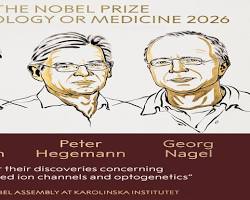
The Nobel Assembly at the Karolinska Institutet announced the 2026 Nobel Prize in Physiology or Medicine, jointly awarding Karl Deisseroth, Peter Hegemann, and Georg Nagel for their pioneering discoveries concerning light-gated ion channels and optogenetics.
Their breakthrough work gives scientists unprecedented precision to manipulate and map neural circuits using light, transforming modern neuroscience.
Key Highlights & Scientific Impact:
- Light-Gated Ion Channels: Hegemann and Nagel discovered and characterized channelrhodopsins—proteins derived from green algae that respond directly to light—laying the molecular foundation for cellular control.
- Optogenetics Breakthrough: Deisseroth successfully integrated these light-sensitive channels into mammalian neurons, enabling researchers to switch targeted nerve cells on and off with laser precision using blue light.
- Neuroscience Revolution: Optogenetics allows scientists to move beyond observing brain activity to establishing direct cause-and-effect relationships for memory, behavior, emotions, and psychiatric conditions.
- Therapeutic Promise: The technology is currently driving research into breakthrough treatments for Parkinson’s disease, epilepsy, addiction, chronic pain, and vision restoration in retinal degeneration.
#NobelPrize #NobelPrize2026 #MedicineNobel #Optogenetics #Neuroscience #BrainResearch #KarlDeisseroth #PeterHegemann #GeorgNagel #MedicalInnovations
- 2026 Nobel Prize in Physiology or Medicine, Karl Deisseroth Peter Hegemann Georg Nagel, optogenetics Nobel Prize, controlling brain with light, light-gated ion channels
- channelrhodopsin discovery, neuroscience breakthroughs 2026, optogenetics disease treatments, Karolinska Institutet Nobel announcement, brain circuit mapping
